If your heating bills have been creeping higher every January, you’re not imagining things. The National Energy Assistance Directors Association (NEADA) projects that the average U.S. home heating expenditure will rise roughly 7.6% this winter, with households heating by electricity facing spikes of more than 10%. And because the U.S. Energy Information Administration estimates that space heating alone accounts for the single largest share of your winter energy bill — often between $640 and $1,650 depending on fuel type — even small improvements in heater efficiency can put real money back in your pocket. The good news? Most of the biggest savings come from maintenance tasks you can do yourself in an afternoon.
Why Heater Maintenance Saves You Money
Think of your heating system the way you’d think of a car. Skip the oil changes, ignore the warning lights, and eventually you’re facing a tow truck bill. The same logic applies to your furnace, boiler, or heat pump — except the “tow truck” can cost $300–$1,200 in emergency repairs, and the “fuel economy” hit shows up on every single utility bill.
Here’s what’s happening under the hood: when filters clog, coils get dusty, or ducts leak, your heater has to work harder and run longer to deliver the same amount of warmth. The U.S. Department of Energy estimates that a dirty air filter alone can cause your HVAC system to use up to 15% more energy. Over a five-month heating season, that’s easily an extra $75–$150 on a typical U.S. household bill.
The three most common heating systems in U.S. homes are:
- Forced-air furnaces (natural gas, propane, or oil) — found in roughly half of American homes.
- Boilers (hot-water or steam, paired with radiators or baseboards).
- Heat pumps (air-source or geothermal, increasingly popular for both heating and cooling).
Fortunately, the heater maintenance tips below apply to all three, with a few system-specific notes where it matters. Let’s get into the checklist.
Your Monthly and Seasonal Heater Maintenance Checklist
Print this out or screenshot it — it’s the single most effective tool you’ll use all winter.
Monthly (October – March)
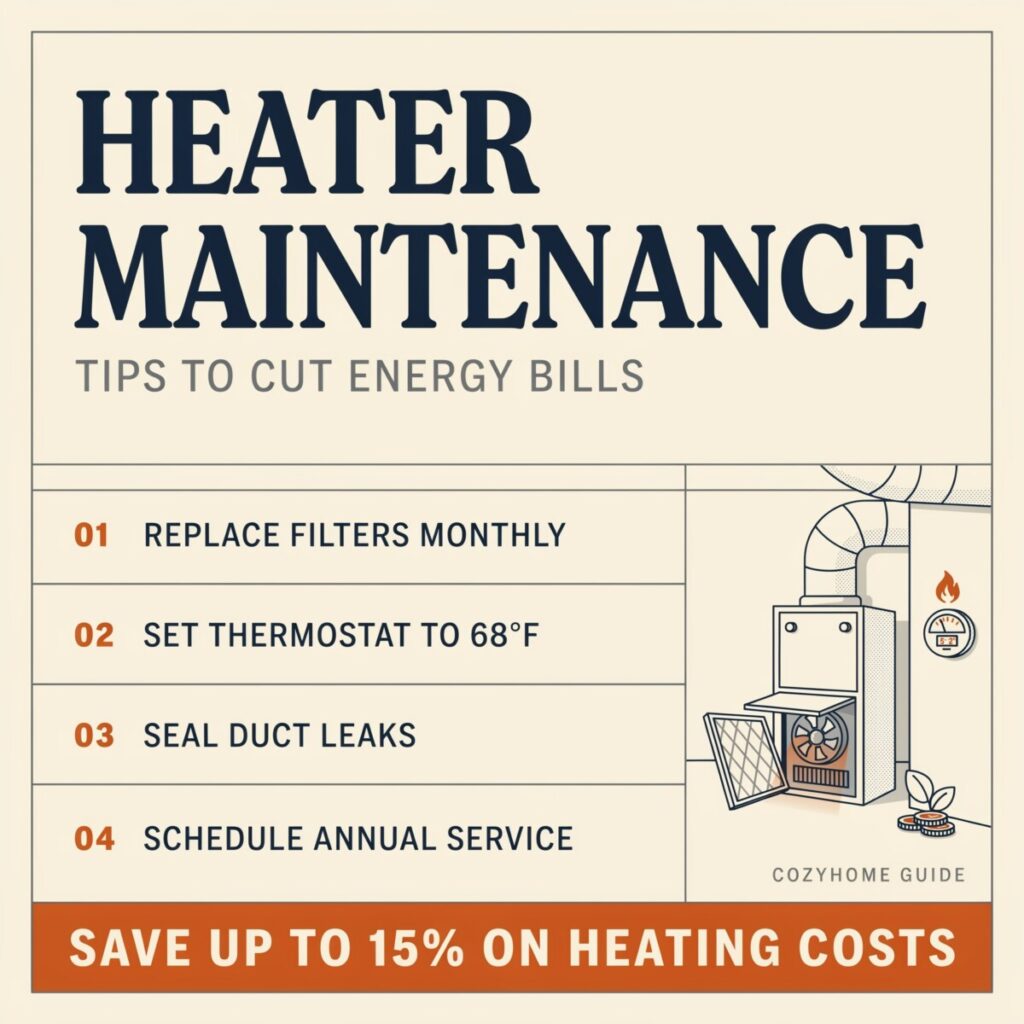
- Replace or clean the air filter (15 minutes, $5–$25). Pull out the filter, hold it up to a light. If you can’t see light through it, swap it. Replace basic fiberglass filters every 30 days and pleated MERV-8 to MERV-11 filters every 60–90 days. Higher-MERV filters catch finer dust but also restrict airflow faster — follow the manufacturer’s schedule. DOE data suggests clean filters alone can cut HVAC energy use by 5–15%, which translates to roughly $7–$20 per month on a typical bill.
- Walk the vents and registers (5 minutes). Make sure rugs, furniture, curtains, and holiday decorations aren’t blocking supply or return vents. A blocked return forces the blower to strain; a blocked supply vent creates pressure imbalances that leak conditioned air into walls.
- Check thermostat settings (2 minutes). If you leave the heat at 72°F around the clock, you’re overpaying. A thermostat setback of 7–10°F for 8 hours a day (while you sleep or are at work) can save up to 10% annually on heating, per DOE.
Start-of-Winter (November)
- Inspect around the unit — clear a 3-foot perimeter. Remove boxes, paint cans, cleaning supplies, and anything flammable from around the furnace, boiler, or indoor heat-pump air handler.
- Test carbon monoxide detectors and smoke alarms. Press the test button and replace batteries. CO is odorless and potentially lethal — this is non-negotiable, especially for gas and oil systems.
- For heat pumps: walk the outdoor condenser. Clear leaves, pine needles, and mulch from around the unit, and hose off the coils if they’re dusty. Keep at least 2 feet of clearance on all sides.
Mid-Winter (January)
- For heat pumps: after snowstorms, brush snow off the top and sides of the outdoor unit and make sure the defrost cycle is running (a brief puff of steam is normal; a block of ice is not).
- Bleed radiators (if you have hot-water heat). A hissing radiator valve that’s cool at the top is full of trapped air — a $5 radiator key fixes it in two minutes and restores even heat.
- Listen for new sounds — banging, squealing, or short cycling are all early warning signs (see the troubleshooting section below).
End-of-Season (April – May)
- Schedule your annual professional tune-up for forced-air furnaces and boilers, or the spring check for heat pumps (they benefit from twice-yearly service since they run year-round).
- Leave the system fan on “auto,” not “on,” over the summer — running it 24/7 adds humidity and cost.
📋 Printable Monthly Heater Maintenance Checklist
☐ Replace or inspect air filter
☐ Clear all vents and returns of obstructions
☐ Verify thermostat setback schedule (day/night/away)
☐ Check CO detector and smoke alarm batteries
☐ Walk 3-foot clearance around heating equipment
☐ For heat pumps: clear debris from outdoor coil
☐ Note any new noises, odors, or comfort complaints
Simple DIY Efficiency Upgrades Under $200
Once basic maintenance is handled, these low-cost improvements deliver the biggest bang for your heating bill:
1. Install a programmable or smart thermostat ($50–$250).
ENERGY STAR-certified smart thermostats save an average of 8% on heating and cooling, roughly $50 per year, with some field studies showing 10–12% heating savings. Models like the Ecobee, Google Nest, and Honeywell T9 pay for themselves in 1–3 winters. Many utilities offer rebates of $50–$100, so check your provider before you buy.
2. Weatherstrip drafty doors and windows ($15–$40, one afternoon).
A $10 door sweep and a roll of foam weatherstripping can plug the biggest air leaks in your home. Hold a lit candle near sills and thresholds on a windy day — if the flame flickers, seal it.
3. Insulate exposed ductwork in unheated spaces ($50–$150).
If you can reach supply and return ducts in an attic, crawlspace, or garage, wrap them with R-6 to R-8 insulated duct sleeves and seal joints with mastic (not shiny duct tape — it peels). The DOE estimates that sealing and insulating ducts can improve heating system efficiency by as much as 20%.
4. Boost attic insulation (variable cost, big payoff).
The U.S. attic insulation “R-value” target is R-38 to R-60 depending on your climate zone. If you can see the attic floor joists, you likely need more. Blown-in cellulose runs roughly $1–$2 per square foot DIY and can cut heating loss through the ceiling by 15–25%.
5. Insulate hot-water pipes from your boiler ($20–$60).
Foam pipe sleeves on the first 6 feet of pipe leaving a boiler prevent heat loss before the water even reaches your radiators.
6. Bleed radiators and balance the system (free).
A cool-top, hot-bottom radiator is wasting heat — bleed it until water dribbles out, then re-balance the system by partially closing valves on radiators nearest the boiler.
A Real-World Example
The Martinez family in Columbus, Ohio, were paying an average of $285/month for natural gas heat in their 1,800-sq-ft home. After replacing three seasons-old filters, sealing attic bypasses with $30 of foam, installing a $149 smart thermostat (with a $75 utility rebate), and weatherstripping two exterior doors, their mid-winter bills dropped to roughly $215/month — about $420 saved in one heating season, with roughly $180 in DIY investment.
When to Call a Professional
Not every heater problem is a weekend project. Call a licensed HVAC technician if you notice:
- Unusual noises: banging, grinding, squealing, or loud booms at startup.
- Persistent odors: a rotten-egg smell (possible gas leak — leave the home and call your gas utility immediately), burning plastic, or soot near registers.
- Frequent short cycling (turning on and off every few minutes).
- Sudden loss of heat despite a clean filter and working thermostat.
- Visible soot, rust, or water pooling around the unit.
- Pilot light that keeps going out or burns yellow instead of blue.
- Bills rising despite maintenance — often a sign of a bigger issue like a cracked heat exchanger.
Recommended timing for pro service:
- Forced-air furnaces and boilers: once a year, ideally in early fall.
- Heat pumps: twice a year (spring and fall), since they handle both heating and cooling.
What a professional tune-up includes ($89–$200 typical): combustion analysis, heat-exchanger inspection, blower and belt check, electrical connection tightening, refrigerant-charge verification (heat pumps), thermostat calibration, and safety-control testing. Most techs also clean the burner assembly and condensate drain.
🔎 Searching for an “HVAC tune-up near me”? Look for NATE-certified technicians, check BBB and Google reviews, and ask for a written checklist of what’s included before booking.
Long-Term Investments That Pay Off
If your heater is approaching 15–20 years old, strategic upgrades can deliver decade-long savings.
- High-efficiency furnace replacement. Modern gas furnaces have AFUE ratings of 95–98% (meaning 95–98 cents of every dollar of fuel becomes heat, vs. 60–80 cents for old units). Upgrading can cut heating fuel use by 20–40%.
- ENERGY STAR heat pump. Look for an HSPF rating of 9.0 or higher for heating efficiency and a SEER2 of 16+ for cooling. In moderate climates, heat pumps now heat homes for roughly half the cost of electric resistance or older gas systems.
- Professional duct sealing and balancing. A specialist using Aeroseal or manual mastic work can recover the 20–30% of conditioned air the average U.S. home loses through leaky ducts.
- Zoned heating or ductless mini-splits. Letting you heat only occupied rooms, these systems pair especially well with open floor plans and additions.
Rebates and tax credits: The federal Energy Efficient Home Improvement Credit (25C) currently covers up to 30% of qualifying heat pump, furnace, and insulation costs (capped annually per category). Most utilities and state energy offices layer on additional rebates — check energystar.gov/rebate-finder and your state energy office before you buy.
Quick Troubleshooting Tips
Before calling for service, run these quick checks:
| Symptom | First Check |
|---|---|
| Furnace won’t start | Power switch by the unit, circuit breaker, thermostat batteries, pilot/igniter. |
| Uneven heat room-to-room | Blocked vents, closed dampers, leaky ducts, or (for radiators) trapped air — bleed them. |
| Short cycling | Dirty filter (most common cause), oversized unit, or thermostat mounted near a heat source or direct sun. |
| Cold air from vents | For heat pumps, this may be normal during defrost cycles; for furnaces, check the pilot or igniter. |
| Whistling or high-pitched noise | Closed vents creating static pressure — open a few and recheck the filter. |
Safety rule of thumb: if you smell gas, see smoke, or feel unsure about any of these steps, shut the system off at the breaker and call a pro. No repair is worth the risk.
Take Action Today — And Keep the Savings Going
Here’s what you’ve just learned: a clean filter, clear vents, a smart thermostat, sealed ducts, and one annual professional tune-up can shave 10–25% off a typical winter heating bill — that’s $150 to $500+ back in your pocket, plus fewer breakdowns, a safer home, and years of extra life from your equipment.
Your next three moves:
- Today: walk to your furnace or air handler and check the filter.
- This week: install or program a smart thermostat and claim any available utility rebate.
- This month: book your annual HVAC tune-up before the first hard freeze.
Stay warm, stay efficient, and keep those energy bills where they belong — in the past.