You’re tiptoeing through your house at 2 a.m., desperately trying not to wake the baby, when squeeeeak-creak—your bedroom door announces your presence to the entire neighborhood. Or maybe it’s your front door that sticks shut during a thunderstorm, leaving you stranded outside in the pouring rain. We’ve all been there. Doors are among the most frequently used elements in your home, opening and closing thousands of times each year. It’s no wonder they develop common door issues like squeaks, sticking, and misalignment.
Doors wear out due to multiple factors: seasonal humidity changes cause wood to swell and contract, foundations settle over time shifting door frames, and everyday wear takes its toll on hinges and hardware. According to finehomebuilding.com, even minor settling can throw door alignment off by fractions of an inch that make the difference between smooth operation and constant frustration.
Here’s what you’re likely dealing with: squeaky hinges, sticking or binding doors, doors that won’t latch properly, warped or swollen panels, drafts, loose knobs, pocket door problems, paint buildup, seasonal expansion issues, and latch misalignment. The good news? Most door repair problems can be fixed with basic tools and less than an hour of your time—saving you the $100-$500 service call to a professional. Whether you’re dealing with an interior bedroom door, your main entryway, or a closet pocket door, these step-by-step fixes will have your doors operating smoothly again. No special skills required—just follow our guide to reclaim quiet, functional doors throughout your home.
Tools and Materials Needed
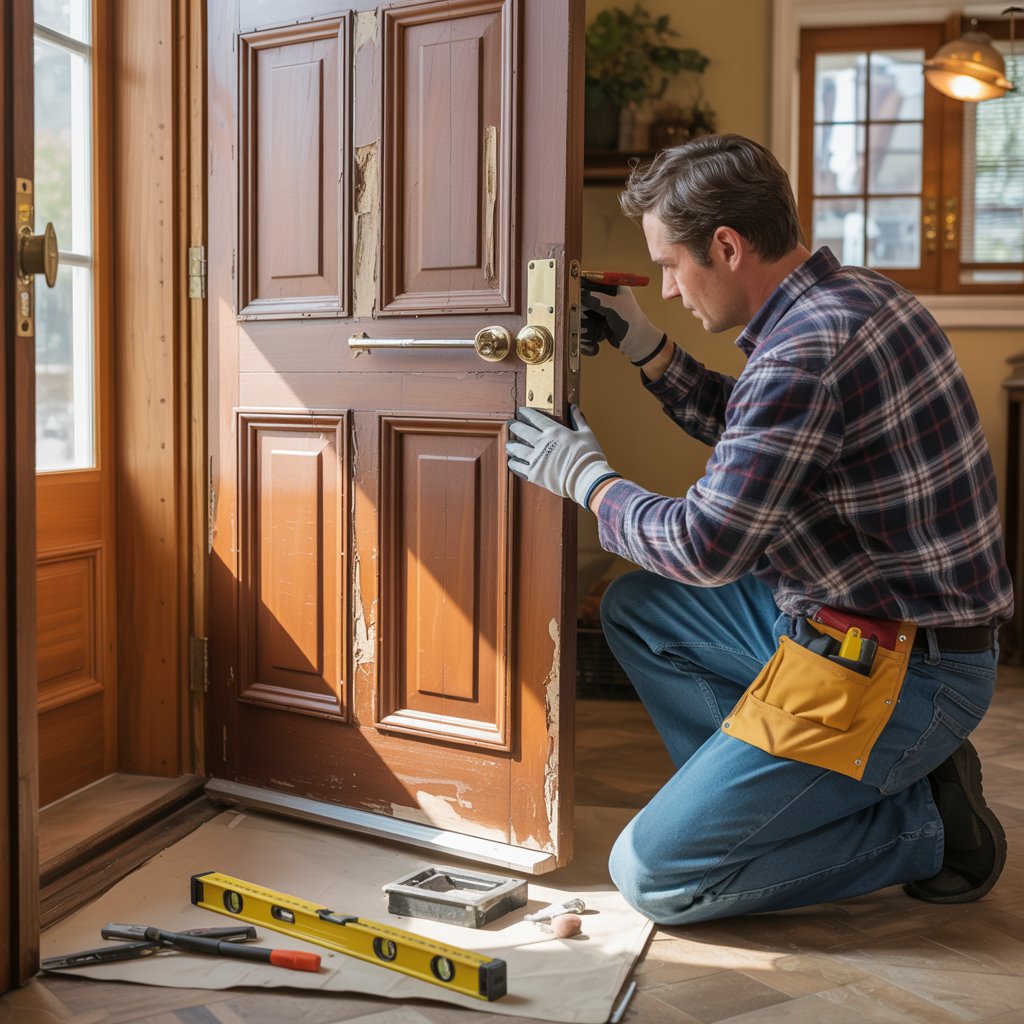
Before tackling any DIY door latch repair, gather these essentials:
- Screwdriver set (Phillips and flathead)
- Cordless drill with assorted bits
- Hammer and small nails
- Wood shims (cardboard works in a pinch)
- Lubricant (silicone-based or 3-in-1 oil)
- 80- and 120-grit sandpaper or sanding block
- Wood filler for stripped screw holes
- Level (12-24 inches)
- Chalk or lipstick for alignment testing
- Metal file for strike plate adjustments
Safety first: Wear work gloves when handling sharp tools, and always unplug power tools when not in use. Most items can be found at your local Home Depot, Lowe’s, or Amazon for under $30. frontdoor.com recommends keeping a basic door repair kit in your garage for quick fixes—having these tools on hand means you can solve most common door issues immediately rather than waiting for a professional.
Problem 1: Squeaky Hinges
That ear-piercing squeeeeak every time you open a door isn’t just annoying—it’s a sign your hinges need attention. Squeaks typically happen when metal parts rub together without proper lubrication, or when rust builds up in the hinge knuckles. Over time, the constant movement wears down the metal, creating friction that produces that signature sound.
The fix is surprisingly simple. First, tighten all hinge screws—loose screws create movement that exacerbates noise. If screws spin freely, fill the hole with toothpicks dipped in wood glue, let dry, then reinstall the screw. Next, remove the hinge pin by tapping upward with a nail and hammer. Clean off any rust with steel wool, then apply a lubricant. While many reach for WD-40, lowes.com advises against it—it attracts dust and dirt that will make the problem worse within weeks. Instead, use silicone spray or 3-in-1 oil for longer-lasting results. Reinsert the pin and work the door back and forth to distribute the lubricant.
For stubborn squeaks, try this pro tip: heat the hinge with a hair dryer for 30 seconds to expand the metal slightly, apply lubricant, then let cool. The contraction creates a tighter seal that keeps lubricant in place. Within minutes, you’ll go from an ear-splitting creak to silent, smooth operation—no professional needed for this fix squeaky door solution.
Problem 2: Sticking or Binding Doors
Sticking doors are one of the most common door repair problems
When your door rubs against the frame or floor, it’s usually due to one of three issues: seasonal expansion, hinge sag, or structural settling. Let’s break down how to diagnose and fix each scenario.
Diagnosing the Binding Location
First, identify where the binding occurs:
- Top latch side binding: Often caused by seasonal expansion or a racked frame
- Bottom latch side dragging: Usually indicates building settlement
- Entire latch side binding: Could be paint buildup or significant swelling
Use the lipstick test recommended by frontdoor.com: Rub lipstick on the door edge, close it, then reopen to see exactly where contact occurs. This precision targeting prevents unnecessary sanding or planing.
Step-by-Step Fixes
- Check hinge tightness: Tighten all hinge screws on both door and frame sides. Loose hinges are the #1 cause of binding doors.
- Address seasonal swelling: During humid months, wood doors absorb moisture and expand. finehomebuilding.com suggests planing the swollen area—but only during peak humidity so the door won’t become too loose in dry months. Remove paint first, use sharp blades, and take shallow cuts.
- Fix sagging doors: Replace the top hinge’s middle screw with a 3-inch version that reaches the stud. This pulls the frame upward, correcting alignment. For doors dragging on the floor, use the longer screw in the bottom hinge instead.
- Shim misaligned frames: If the frame itself is out of square, add thin cardboard shims behind hinges. Place shims at the bottom hinge to lift the latch side, or at the top hinge to lower it.
| Symptom | Likely Cause | Quick Fix |
|---|---|---|
| Door sticks at top latch corner | Seasonal expansion | Light sanding of top edge |
| Door drags on floor with gap at top | Building settlement | Longer screw in bottom hinge |
| Even binding along latch side | Paint buildup | Scrape mating surfaces |
| Binding only when humid | Moisture absorption | Dehumidifier; seal raw wood |
For severe cases where the door binds along the entire edge, you may need to deepen hinge mortises or adjust the strike plate—procedures we’ll cover next.
Problem 3: Door Won’t Latch or Close Properly
When your door refuses to latch, it’s not just inconvenient—it compromises security. This how to fix door that won’t latch issue usually stems from misalignment between the latch bolt and strike plate, often caused by settling foundations or loose hinges.
The Diagnostic Process
- Perform the lipstick test: As described earlier, this shows exactly where the latch contacts the strike plate.
- Check for gaps: With the door closed, look for uneven gaps around the frame. A proper door should have consistent 1/8-inch reveals on all sides.
- Test frame squareness: Place a level across the head (top) of the frame and down both sides. If the frame isn’t plumb or level, you’re dealing with structural movement.
Alignment Fixes
- Adjust the strike plate:
- Loosen the two screws slightly
- Insert a business card or thin shim behind the plate on the side needing adjustment
- Retighten screws and test
- For larger adjustments, chisel out the mortise deeper where needed
- Deepen the strike hole: If the latch hits the plate but won’t engage, use a metal file to enlarge the hole slightly downward (for a high latch) or upward (for a low latch).
- Reposition hinges: For significant misalignment, deepen hinge mortises on the jamb side. Remove the hinge, chisel out the mortise 1/16 inch deeper on the side needing adjustment, then reinstall.
thetoolstrunk.com emphasizes that 90% of latching issues can be fixed by adjusting the strike plate position—often requiring just a few millimeters of movement. For stubborn cases where the frame itself has shifted, you may need to add shims behind the entire hinge mortise to reposition the door within the frame.
Problem 4: Warped or Swollen Doors
Wood doors naturally respond to humidity changes, but excessive warping creates serious door repair problems. Swelling typically occurs along the grain (making doors wider), while warping involves twisting that prevents proper closure.
Identifying the Cause
- Moisture absorption: Common in bathrooms or exterior doors exposed to rain
- Uneven drying: When one side of the door dries faster than the other
- Poor finishing: Unsealed edges absorb moisture more readily
Repair Strategies
- Dry out the door: For minor swelling, run a dehumidifier in the room for several days. Place fans to circulate air around the door.
- Reverse warping with clamps:
- Identify the direction of warp (which side is convex)
- Apply moisture to the concave side with a damp cloth
- Clamp the door flat between two straight boards
- Allow to dry completely (may take days)
- Planing solution: For swollen edges, carefully plane or sand the affected area. Always work with the grain, take light passes, and check fit frequently. Seal the raw wood immediately with primer and paint.
- Prevent recurrence: Apply a quality exterior-grade finish to all door edges, not just faces. For interior doors in humid areas, consider moisture-resistant finishes like polyurethane.
lowes.com notes that hollow-core doors are particularly vulnerable to moisture damage—if water has penetrated, replacement may be your only option. Solid wood doors, however, can usually be restored with these warped door solutions.
Problem 5: Drafts and Poor Insulation
Drafty doors waste energy and make your home uncomfortable. Exterior doors are most susceptible, but interior doors between temperature zones (like basements) can also leak air.
Quick Fixes That Work
- Replace worn weatherstripping: Peel off old strips and clean the channel thoroughly before installing new V-strip or foam tape
- Install a door sweep: Attaches to the bottom of the door, sealing the gap between door and threshold
- Adjust the threshold: Most exterior doors have an adjustable aluminum threshold—loosen set screws and raise or lower as needed
- Apply foam tape: Around the interior perimeter where the door meets the stop molding
According to thetoolstrunk.com, properly sealed doors can reduce heating and cooling costs by up to 15%. For older homes with uneven floors, consider an automatic door bottom that seals when closed but retracts when opened.
Problem 6: Loose or Broken Doorknobs/Locks
Wobbly knobs and stiff locks aren’t just annoying—they’re security risks. Most DIY door latch repair issues with hardware stem from loose mounting screws or internal mechanism problems.
Step-by-Step Repair
- Tighten visible screws: On both interior and exterior knob assemblies
- Access hidden set screws: Often concealed under decorative caps—pry gently with a flathead screwdriver
- Check latch mechanism: Remove the latch assembly and clean with compressed air
- Lubricate internals: Use graphite powder (not oil) which won’t attract dirt
- Replace worn parts: If the latch bolt sticks or retracts unevenly, replace the entire mechanism
For exterior locks with key issues:
- Clean the keyway with a small brush
- Apply graphite lubricant sparingly
- If keys turn stiffly, the cylinder may need replacement
lowes.com warns that excessive lubrication can actually cause lock mechanisms to gum up—less is more when maintaining door hardware.
Pocket Sliding Door Issues
Pocket doors save space but introduce unique challenges. When they stick, jump tracks, or become difficult to open, it’s usually due to track debris or roller misalignment.
Track Troubleshooting
- Clean the track: Remove the door stop molding and vacuum out dust and debris
- Lubricate rollers: Apply silicone spray to roller bearings (avoid oil-based lubes that attract dirt)
- Adjust roller height: Locate the adjustment screw (usually on top of the door) and turn clockwise to raise, counterclockwise to lower
- Realign the door: If the door binds at one end, loosen the roller brackets slightly and shift the door horizontally
For doors that won’t stay open, check if the hold-open mechanism (if present) needs cleaning or adjustment. Most pocket door problems can be solved in under 30 minutes with basic tools.
When to Call a Pro
While most door repair problems are DIY-friendly, certain situations warrant professional help:
- Structural issues: If multiple doors in your home are problematic, you may have foundation settlement requiring engineering expertise
- Major warping: Doors with severe twists often can’t be salvaged
- Smart lock integration: Complex electronic systems may need specialized installation
- Historic doors: Original hardware in older homes may require preservation expertise
If your fixes only provide temporary relief or the problem worsens, consult a door specialist. As finehomebuilding.com notes, “When the door frame itself is compromised, professional reframing may be necessary.”
Prevention Tips and Maintenance Schedule
Avoid future headaches with these simple habits:
- Quarterly: Tighten all hinge and knob screws
- Biannually: Lubricate hinges and locks with appropriate products
- Before winter: Check weatherstripping and replace if compressed
- After painting: Ensure no paint has sealed the door to the frame
Keep a small bottle of 3-in-1 oil and a screwdriver in your cleaning caddy for quick touch-ups. For exterior doors, apply a fresh coat of finish every 2-3 years to prevent moisture damage. These small efforts prevent 80% of common door issues before they start.
Conclusion
From squeaky hinges to sticking doors, most common door issues have simple, affordable solutions you can implement today. By understanding the root causes—whether seasonal expansion, loose hardware, or minor settling—you can restore smooth operation to every door in your home. Remember these key takeaways: tighten screws first, use proper lubricants, and diagnose precisely before making adjustments. With the right tools and these proven techniques, you’ll save hundreds in service calls while gaining the satisfaction of a job well done. Try these fixes today and share your success stories in the comments! Subscribe for more practical DIY guides, and download our free [Door Maintenance Checklist] to keep your home’s entrances operating perfectly year-round.
Frequently Asked Questions
Q: Can I fix a steel exterior door the same way as a wood door?
A: Steel doors share many repair techniques with wood doors (hinge tightening, strike plate adjustment), but avoid planing or sanding metal surfaces. Focus on hardware adjustments and weatherstripping—steel doors rarely warp but can develop alignment issues from frame movement.
Q: My door sticks only in summer—should I plane it?
A: Only as a last resort. First try adjusting hinges and strike plates. If planing is necessary, do it during peak humidity so the door won’t become too loose in winter. Always seal newly exposed wood immediately.