Ever stared at streaky windows after a spring rain in Chicago—sun finally out, light flooding in, and all you can see are smears? You scrubbed, you sprayed, you wiped—and somehow made things worse. Sound familiar? You’re not alone. Millions of US homeowners wrestle with the same frustration every season. But here’s the good news: streak-free windows aren’t a privilege reserved for professional cleaners. With the right window cleaning tricks, you can get crystal-clear results using tools and ingredients you probably already have at home.
Clean windows do more than look nice. They maximize natural light, boost curb appeal, and even protect your glass from long-term mineral damage. Whether you’re prepping your home for sale or simply tired of squinting through a film of grime, these 15 window cleaning tips will transform the way you tackle this chore. We’ll cover everything from DIY window washing recipes to professional squeegee techniques—no harsh chemicals required. These window cleaning tips will give you sparkling results without the hassle.
Why Windows Get Streaky: Common Culprits
Before you can fix the problem, it helps to understand what’s causing it. Streaks and smears aren’t random—they have specific causes, and many of them are uniquely tied to where you live in the US.
Top 5 reasons your windows keep streaking:
- Hard water mineral deposits – Especially common in Midwest states like Kansas and Indiana, hard water leaves calcium and magnesium residue that dries into a white haze.
- Pollen buildup – In the South and Mid-Atlantic, spring pollen coats windows in a sticky yellow film that bonds with cleaning solution if not pre-rinsed.
- Winter road salt residue – In the Northeast and Great Lakes region, salt spray from roads clings to ground-floor windows all season long.
- Wrong cleaning product – Many commercial sprays contain soapy residues that dry into streaks, especially in direct sunlight.
- Dirty or wrong tools – Paper towels, old rags, and newspaper (on tinted glass) all leave lint, fibers, or chemical residue behind.
Knowing your regional culprit helps you choose the right solution before you even pick up a cloth.
Essential Window Cleaning Tools and Supplies
The difference between a professional result and a frustrating smear often comes down to your tools. Here’s what the pros actually use—and what you can find on Amazon without breaking the bank.
Best Window Cleaning Tools: Comparison Table
| Tool | Best For | Vs. Alternative | Price Range |
|---|---|---|---|
| Ettore Squeegee (10″–18″) | Large panes, outside glass | Better than rags—no streaks | $12–$30 |
| Unger Microfiber Cloth | Detailing, interior glass | Better than paper towels—lint-free | $8–$20 (pack) |
| Scrubber/Applicator Wand | Loosening heavy grime | Better than sponges—more surface contact | $10–$20 |
| Extension Pole (8–16 ft) | 2nd-floor or high windows | Safer than a ladder for most jobs | $20–$45 |
| Spray Bottle (16–32 oz) | DIY solution application | Better than store sprays—no residue additives | $3–$8 |
| Bucket with Clip-on Wringer | Outdoor washing | Better than a bowl—controls water, saves trips | $15–$25 |
| Reusable Microfiber Mop Pad | Eco-friendly glass scrubbing | Better than disposable pads—washable up to 500x | $10–$18 |
Pro tip: Skip generic store-brand squeegees. Ettore and Unger are the gold standards used by professional window cleaners across the US, and both are widely available on Amazon. Microfiber cloths for windows are non-negotiable—they trap particles instead of pushing them around.
DIY Window Cleaning Solutions: Natural Recipes
You don’t need Windex to get streak-free windows. In fact, many store-bought sprays contain ammonia or surfactants that leave residue. These natural window cleaners work just as well—often better—and are safer for your family, pets, and the planet.
5 Homemade Window Cleaner Recipes
1. Classic Vinegar Window Cleaner (Most Popular)
- Mix: 1 part white distilled vinegar + 1 part distilled water
- How to use: Pour into a spray bottle, apply to glass, wipe with microfiber
- Best for: Everyday maintenance, light grime
- Pro: Cuts grease and hard water; no streaks when used with a squeegee
- Con: Strong smell (fades quickly); avoid on stone or marble window sills
2. Rubbing Alcohol Glass Cleaner (Fast-Drying)
- Mix: 1 cup rubbing alcohol (70%) + 1 cup water + 1 tbsp white vinegar
- Best for: Cold weather cleaning (won’t freeze on contact)
- Pro: Evaporates fast, streak-free shine even in winter
- Con: Flammable—keep away from open flame
3. Dish Soap Solution (Heavy-Duty Grime)
- Mix: 2 cups water + ½ tsp Dawn dish soap
- Best for: Outdoor windows caked with bird droppings or pollen
- Pro: Cuts through greasy buildup; cheap and effective
- Con: Over-sudsing causes streaks—use soap sparingly
4. Citrus Spray (Eco-Friendly Window Cleaning)
- Mix: Peels from 2 lemons steeped in white vinegar for 2 weeks, then diluted 1:1 with water
- Best for: Eco-conscious households, light odors
- Pro: Natural degreaser, pleasant scent
- Con: Longer prep time; citrus can attract bugs if left on screens
5. Baking Soda Paste (Hard Water Stains)
- Mix: 3 tbsp baking soda + enough water to form a paste
- Apply: Rub onto mineral deposits with a damp cloth; let sit 5 minutes, then rinse
- Best for: Stubborn Midwest hard water spots
- Pro: Gentle abrasive removes buildup without scratching
- Con: Rinse thoroughly or residue will re-streak
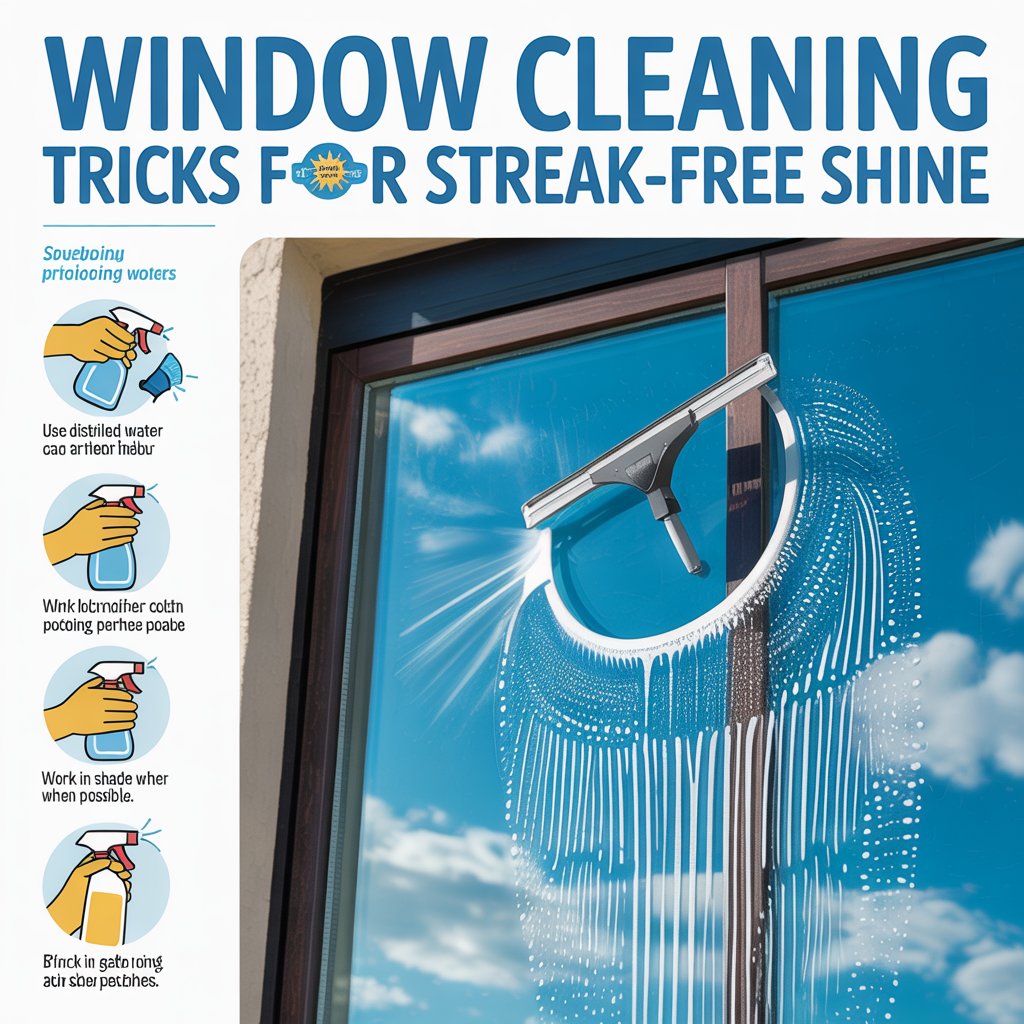
Step-by-Step Window Cleaning Tricks for Streak-Free Shine
This is the heart of it. Follow these steps in order and you’ll get professional-level results every single time.
Step 1: Remove Screens and Dust First
Before any liquid touches your window, remove the screen and set it aside. Use a dry microfiber cloth or a soft-bristle brush to dust the frame, sill, and glass surface top to bottom. Skipping this turns dust into muddy streaks the moment your cleaner hits it.
Step 2: Pre-Rinse Heavily Soiled Windows
If your windows have caked pollen (looking at you, Atlanta homeowners), bird droppings, or winter salt crust, pre-rinse with a gentle stream from the garden hose before applying any solution. This prevents your cleaner from becoming a gritty paste.
Step 3: Apply Solution Top to Bottom—Always
Spray or apply your cleaner starting at the top of the pane and working down. Gravity is your friend. Working bottom-up causes drips to run through already-cleaned areas.
Step 4: Master the Squeegee Technique
This is where most DIYers go wrong. Here’s the correct method:
- Start at the top corner and pull the squeegee horizontally across the pane in a firm, smooth stroke.
- Wipe the blade with a clean cloth after each pass.
- Overlap each stroke by 1–2 inches to catch any missed liquid.
- Finish with a vertical stroke along the sides to catch edge drips.
Pro Tip: For large windows, use an S-pattern technique—arc the squeegee in an S-shape from one side to the other for even pressure and complete coverage. This is the move professional window cleaning crews use on commercial buildings.
Step 5: The Microfiber Folding Method
When using a cloth instead of a squeegee, fold your microfiber cloth into quarters. Use the first face for scrubbing, then refold to a fresh face for the final buff. This gives you four clean surfaces per cloth and prevents redepositing grime. Circular motions cause streaks—always wipe in straight lines.
Step 6: Inside vs. Outside—Wipe in Opposite Directions
Here’s a trick that sounds simple but is game-changing: wipe the inside pane horizontally and the outside pane vertically (or vice versa). If a streak appears after you’re done, you’ll instantly know which side it’s on by the direction it runs.
Step 7: High-Rise Window Cleaning Hacks for 2nd-Floor Apartments
Don’t risk your safety on a ladder for second-floor windows. Instead:
- Use an extension pole with a squeegee attachment (Unger and Ettore both make these for under $50).
- Fill a bucket with your cleaning solution and use a scrubber wand to apply, then follow with the pole-mounted squeegee.
- For apartment balconies, extendable microfiber mop heads let you clean sliding door glass from the inside safely.
Ladder safety rule: If you must use a ladder, always have a spotter, never lean over the side rail, and wear rubber-soled shoes.
Step 8: Clean on a Cloudy Day (Not in Direct Sun)
This is one of the most overlooked window cleaning hacks. Direct sunlight dries your cleaner before you can wipe it off, leaving streaks baked into the glass. Choose an overcast day or clean windows in the shade.
Step 9: Seasonal Prep Tips
- Spring: Rinse off pollen first; use a vinegar solution to cut through sticky residue.
- Summer: Clean early morning before heat builds; squeegee quickly to prevent fast evaporation.
- Fall: Clean gutters before windows—overflowing gutters splash dirty water onto glass.
- Pre-winter wash: Do a thorough clean before temperatures drop. Salt, ice, and frost are harder to remove once they’ve bonded. A light coat of Rain-X after cleaning repels water and reduces winter buildup.
Step 10: Don’t Forget the Window Tracks
Filthy tracks contaminate clean glass every time you open the window. Vacuum the track first, then spray with your vinegar solution and scrub with an old toothbrush. Wipe dry. Takes 90 seconds and makes a visible difference.
Advanced Pro Window Cleaning Hacks
Ready to go beyond the basics? These are the tricks professional cleaners use that most homeowners never discover.
1. Newspaper buffing (on non-tinted glass) Old newspaper is mildly abrasive and absorbs residue without leaving lint. Once you’ve squeegeed, a final buff with a crumpled sheet of newspaper removes any remaining haziness. Note: Do not use on tinted windows—the ink can smear.
2. Black stripe removal The black rubber residue left by window tracks? Rub with a Mr. Clean Magic Eraser dampened with your vinegar solution. Wipe immediately with a microfiber cloth.
3. Outdoor hose method for large exterior panes Pros on big residential jobs often skip the spray bottle entirely. They soak the glass with a hose, scrub with a sudsy applicator wand, then squeegee top-to-bottom. Rinse and squeegee once more. Fast, thorough, streak-free.
4. UV protectant spray after cleaning Products like Rain-X Glass Treatment (available at AutoZone or Amazon) create a hydrophobic coating that repels rain, dust, and pollen for weeks after application. Apply after a thorough clean for windows that practically maintain themselves—especially useful in Florida during hurricane season.
5. Quick-touch-up kit for between deep cleans Keep a spray bottle of 50/50 vinegar-water solution and two folded microfiber cloths in a small caddy under the kitchen sink. For fingerprints and smudges, a 60-second spot clean is all you need. No bucket, no squeegee, no hassle.
Eco-Friendly and Time-Saving Window Cleaning Tips
Sustainability and speed aren’t mutually exclusive. According to the EPA, reducing household chemical use—including switching from ammonia-based sprays to vinegar-based natural window cleaners—meaningfully cuts indoor air pollutants. Here’s how to do it quickly:
- Reusable microfiber pads replace paper towels and last for hundreds of washes. One set pays for itself in a few months.
- No-rinse concentrate formulas (like Ecover or Better Life Glass Cleaner) dilute to fill dozens of bottles from a single purchase.
- 5-minute shower window trick: While the bathroom is still steamy after a shower, wipe down the glass door with a dry squeegee. The steam softens soap scum, and you’re done before you’ve even dried off.
- Batch your window cleaning with other chores. Clean windows on the same day you vacuum—dust you kick up during vacuuming won’t resettle on wet glass if windows are already dry.
Mistakes to Avoid for Perfect Results
Even with great tools and solutions, these six pitfalls can undo all your hard work:
- Cleaning in direct sunlight – Solution dries too fast, leaving streaks baked onto warm glass.
- Using paper towels – They leave lint and fibers that catch light and look terrible.
- Too much soap in your solution – Even a small excess creates sudsing that dries into residue. Less is more.
- Using newspaper on tinted windows – Ink smears and can damage factory tinting.
- Skipping the dust-first step – Wet dust becomes mud. Always dry-dust frames and glass before applying any liquid.
- Reusing a dirty cloth – A cloth that picked up grime on one window deposits it on the next. Use a fresh fold or a fresh cloth for each pane.
Conclusion
Getting streak-free windows doesn’t require expensive equipment or professional fees. It requires the right knowledge, the right tools, and a little patience. Start with a vinegar window cleaner—it’s cheap, effective, and eco-friendly. Pair it with a quality squeegee and microfiber cloths, work top-to-bottom on a cloudy day, and use the S-pattern technique for large panes. Those three changes alone will transform your results.
I once spent an entire Saturday afternoon fighting with a bottle of commercial spray and a roll of paper towels, convinced my bay windows were impossible to clean. Then a neighbor showed me the vinegar-and-squeegee method, and I was done in 20 minutes—with better results than I’d ever gotten before. It genuinely changed the way I approach this chore.
Try the vinegar window cleaner this weekend—your home deserves that streak-free shine! And if this guide helped, share it with someone who’s still wrestling with smeared glass. Drop a comment below with your go-to window cleaning hack—we’d love to hear what works in your part of the country.
Frequently Asked Questions
Q: What’s the best natural window cleaner? A: A 50/50 mix of white distilled vinegar and distilled water is the top-rated DIY option. It cuts grease, dissolves mineral deposits, and dries streak-free with no chemical residue.
Q: Can I use dish soap to clean windows? A: Yes—but use very little (½ tsp per 2 cups of water). Too much soap creates suds that leave a filmy residue when dry.
Q: What’s the best tool for streak-free windows? A: A professional-grade squeegee (Ettore or Unger) combined with a microfiber applicator cloth gives the most consistent streak-free results.
Q: How often should I clean my windows? A: Inside glass every 1–2 months; outside glass every 2–3 months, with spot-cleaning as needed. In high-pollen or coastal areas, outside glass may need more frequent attention.
Q: Is it safe to clean windows with newspaper? A: Only on untinted glass. Newspaper ink can smear on tinted windows or leave residue on colored frames. Microfiber cloths are safer and more effective overall.
Sources: Good Housekeeping Glass Cleaning Guide; EPA Indoor Air Quality Resources; Ettore Professional Window Cleaning Products.