The Ultimate Attic Cleaning Guide to Prevent Mold Growth in US Homes
Your attic is one of the most overlooked spaces in your home — and that neglect can be quietly destroying your property and your health. According to research from the Lawrence Berkeley National Laboratory, nearly 47% of US homes show signs of dampness or mold, and attic mold exposure is linked to approximately 21% of the nation’s 21.8 million asthma cases. Mold doesn’t just smell bad; it rots roof sheathing, compromises insulation R-values, sends spores drifting into your living spaces, and can cost homeowners $10,000 to $30,000+ in remediation if left unchecked.
So why are attics such a magnet for mold? The answer is a toxic trifecta: trapped moisture, poor ventilation, and inadequate insulation. Warm, humid air from bathrooms, kitchens, and dryers rises into the attic. When it contacts cold roof sheathing in winter — or gets trapped behind stagnant air in summer — condensation forms. Within 24 to 48 hours of sustained moisture, mold colonies can take root, per US EPA guidelines.
This attic cleaning guide to prevent mold growth gives you everything you need — from spotting early warning signs and assembling the right safety gear, to executing a professional-grade cleanup and implementing long-term prevention strategies tailored to your US climate zone.
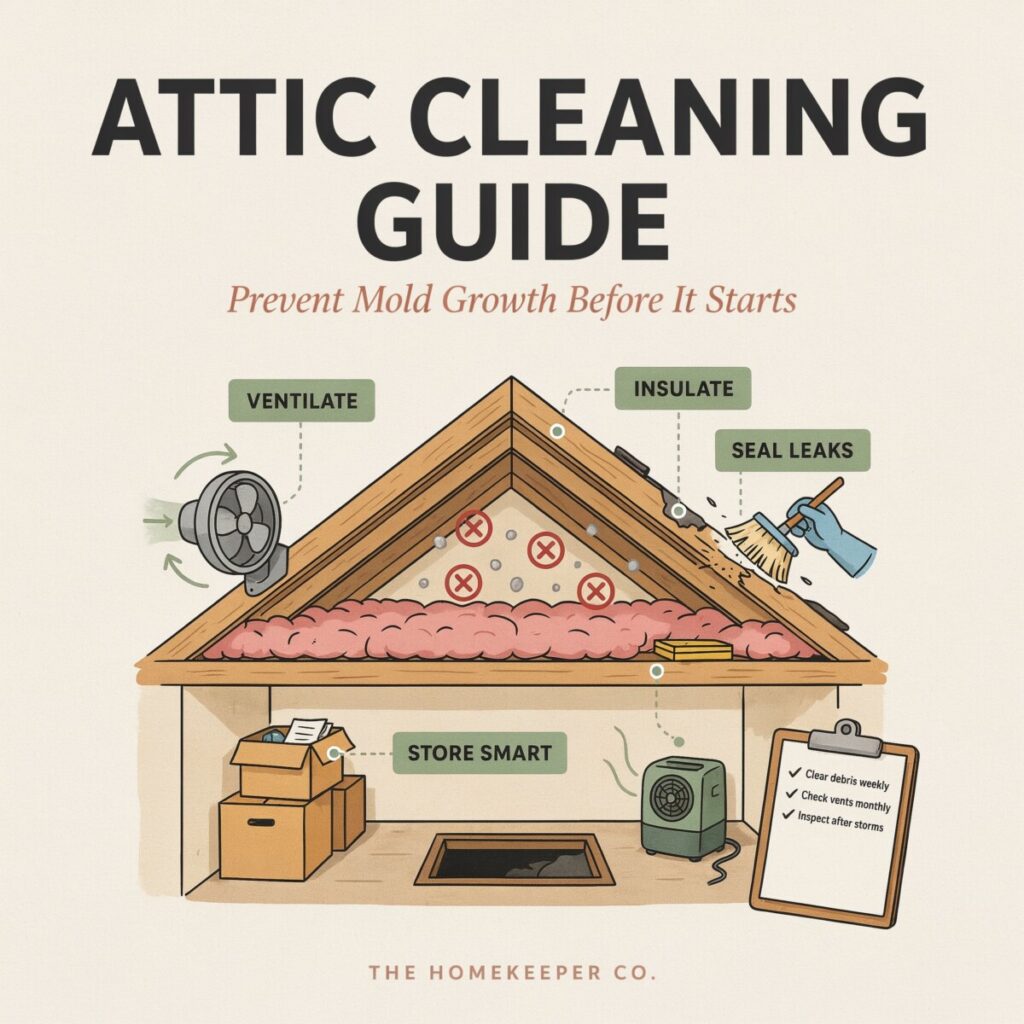
Why Mold Grows in Attics
Common Causes of Attic Mold
Mold requires three conditions to thrive: moisture, organic material, and warmth. Attics supply all three in abundance. Here are the most frequent culprits behind attic mold growth in American homes:
- Moisture intrusion from roof leaks, damaged flashing, or ice dams
- Poor attic ventilation — blocked soffit vents, missing ridge vents, or unbalanced intake/exhaust airflow
- Improperly vented appliances — bathroom exhaust fans, dryer vents, and kitchen hoods that dump moist air directly into the attic instead of outside
- Insulation problems — compressed, wet, or improperly installed insulation that traps moisture against the roof deck
- Air leakage from the conditioned living space below, carrying humid air through unsealed attic hatches, recessed lights, and plumbing penetrations
Attic Mold Health Risks You Shouldn’t Ignore
Even though you don’t spend hours in your attic, attic mold health risks are real. Spores migrate downward through the “stack effect” — the natural airflow pattern where warm air rises and escapes through the attic, pulling replacement air (and spores) from lower levels. Exposure can trigger:
- Respiratory issues — coughing, wheezing, shortness of breath
- Allergic reactions — sneezing, itchy eyes, skin rashes
- Asthma exacerbation, particularly in children and the elderly
- Mold respiratory issues including chronic sinus infections and hypersensitivity pneumonitis in severe cases
Signs Your Attic Has Mold
Catching mold early saves thousands of dollars. Here’s what to look for during your inspection:
| Indicator | What to Look For |
|---|---|
| Visual signs | Black, green, or gray spots on plywood sheathing; white fuzzy or powdery growth on rafters |
| Olfactory signs | A persistent musty, earthy odor when opening the attic hatch |
| Hidden mold | Discoloration behind insulation batts, under roof sheathing, or around vent pipes |
| Structural clues | Warped or delaminating plywood, rusted nails (indicating chronic condensation) |
| Frost in winter | Frost buildup on nail tips or sheathing — a precursor to spring mold blooms |
Pro Tip: Shine a bright LED flashlight at a low angle across the sheathing. This “raking light” technique reveals hidden mold texture that overhead lighting misses.
Tools & Safety Gear Needed for Attic Cleaning
Before you climb into the attic, assemble the right equipment. DIY mold safety is non-negotiable — disturbing mold without protection releases millions of spores into the air.
Protective Equipment
- N95 mask attic cleaning respirator (minimum); upgrade to a half-face P100 respirator for heavy contamination
- Sealed goggles (non-vented to block spores)
- Nitrile or rubber gloves — elbow-length preferred
- Disposable coveralls with elastic cuffs and hood
- Boot covers to prevent tracking spores into living areas
Cleaning Tools
- HEPA vacuum attic unit — a standard shop vac will blow spores right back into the air
- Pump sprayer for applying cleaning solutions
- Stiff-bristle scrub brushes and wire brushes for wood
- Bucket, mild detergent (non-ammonia), and clean rags
- Box fans and a commercial-grade dehumidifier for drying
- Heavy-duty 6-mil plastic bags for contaminated debris
Safety Precautions
- Work during cool morning hours — attic temperatures can exceed 140°F in summer
- Watch for exposed electrical wiring, recessed light housings, and nails protruding through sheathing
- Lay plywood walk boards across joists to avoid stepping through the ceiling below
- Keep a hydration bottle and phone within reach
Step-by-Step Attic Cleaning Process
Follow this proven attic mold removal sequence to get your attic clean and protected.
Step 1: Inspect for Water Leaks and Moisture Sources
Before cleaning, find and eliminate the moisture source. Mold will return within weeks if the underlying problem remains. Check for:
- Roof leaks around chimneys, vent pipes, skylights, and valleys
- Condensation on the underside of sheathing
- Bathroom fans and dryer vents terminating inside the attic
- Plumbing stack leaks and HVAC condensation drain issues
Step 2: Remove Old Insulation and Debris
Wet, moldy insulation cannot be salvaged. Bag it in 6-mil plastic and remove it from the site. Clear out stored items, old cardboard, and construction debris — all of which are mold food sources.
Step 3: Scrub Mold Off Hard Surfaces with Detergent
Mix a solution of warm water and non-ammonia detergent. Scrub all affected wood surfaces — rafters, sheathing, and ridge beams — using a stiff-bristle brush. The EPA recommends damp wiping and scrubbing rather than dry brushing, which aerosolizes spores.
Step 4: Apply a Mold-Inhibiting Solution
After scrubbing, treat surfaces with a mold-inhibiting solution to kill residual spores and prevent regrowth. Options include:
- White vinegar (undiluted) — kills ~82% of mold species
- 3% hydrogen peroxide — effervescent action lifts embedded spores
- Borate mold treatment (e.g., Bora-Care or Tim-bor) — professional-grade, long-lasting protection widely used in the US
Step 5: Dry the Attic Thoroughly
This is the most overlooked step. Deploy box fans for cross-ventilation and run a dehumidifier until the wood moisture content drops below 16% (verify with a moisture meter). Incomplete drying guarantees mold’s return.
Step 6: Replace Insulation with Proper Ventilation
Install new moisture-resistant insulation — and crucially, ensure baffles (venting chutes) are in place between rafters to maintain airflow from soffit to ridge. Never let insulation block soffit vents or touch the roof sheathing.
How to Improve Attic Ventilation to Prevent Mold
Attic ventilation tips are the cornerstone of long-term attic moisture control. A properly ventilated attic maintains temperatures close to outdoor ambient conditions, preventing condensation.
Types of Vents
| Vent Type | Location | Function |
|---|---|---|
| Soffit vents | Under eaves | Intake (cool, dry air enters) |
| Ridge vents | Along roof peak | Exhaust (warm, moist air exits) |
| Gable vents | Gable-end walls | Cross-ventilation |
| Powered attic fans | Roof or gable | Active exhaust (use cautiously) |
The 50/50 rule is critical: 50% of vent area should be intake (soffit) and 50% exhaust (ridge or gable) for balanced airflow. The FHA and US building codes recommend 1 square foot of net free ventilation per 150 square feet of attic floor space — or 1:300 if you have a balanced system with a vapor barrier.
Key Insight: More ventilation isn’t always better. An unbalanced system (all exhaust, no intake) can actually pull conditioned, humid air from your living space into the attic — worsening the problem.
Insulation Best Practices for Mold Prevention
Insulation choice and installation dramatically influence reduce attic humidity outcomes.
- Spray foam insulation (closed-cell) creates an airtight, moisture-resistant barrier — excellent for cathedral ceilings and unvented attic assemblies
- Rigid foam board resists moisture absorption and works well on gable-end walls
- Blown-in cellulose (treated with borates) is naturally mold-resistant but must stay dry
- Fiberglass batts are affordable but trap moisture — never install them flush against sheathing
Critical rule: Maintain a minimum 2-inch air channel between insulation and the roof deck using rafter vents (baffles). Insulation that touches sheathing creates a condensation sandwich.
Roof Leak Detection and Repair
Even a slow, intermittent leak creates the chronic moisture conditions mold craves. Inspect from inside the attic during or immediately after rain for active drips. Common leak points include:
- Chimney flashing — the #1 leak source in older US homes
- Vent pipe boots — rubber seals crack after 10–15 years
- Skylights and roof valleys — ice dam damage is common in attic mold Northeast homes
- Step flashing at wall-to-roof intersections
When to call a professional roofer: If you find active leaks, widespread sheathing rot, or structural sagging, DIY patching is a liability. Licensed roofers can perform infrared moisture scans to find hidden leaks invisible to the naked eye.
Natural vs. Commercial Mold Cleaners
| Cleaner Type | Examples | Pros | Cons |
|---|---|---|---|
| Natural | White vinegar, hydrogen peroxide, tea tree oil | Non-toxic, inexpensive, safe for DIY | Limited residual protection; may require repeat applications |
| Commercial | Borate solutions, Concrobium, antimicrobial encapsulants | Long-lasting prevention, professional-grade | Higher cost; some require PPE and ventilation |
Hybrid approach: Use vinegar or hydrogen peroxide for the initial kill, then follow up with a borate mold treatment for long-term residual protection — a strategy widely recommended by certified mold inspector professionals.
When to Hire a Professional Attic Cleaning Service
The US EPA draws a clear line: if mold covers more than 10 square feet, hire a professional. Beyond size, call in the experts when:
- Mold has penetrated deep into wood or drywall (not just surface growth)
- You suspect toxic black mold (Stachybotrys chartarum)
- The HVAC system is contaminated
- You have pre-existing respiratory conditions or immune system concerns
Professional attic mold remediation offers benefits DIY cannot match: full containment with negative air pressure, HEPA air scrubbers, industrial-grade antimicrobial treatments, and third-party clearance testing. When selecting a service, verify:
- IICRC or ACAC certifications
- State-licensed mold assessment and remediation (required in TX, FL, NY, LA, and others)
- Written scope of work, warranty, and post-remediation verification
Long-Term Mold Prevention Tips
A clean attic stays clean only with ongoing vigilance. Build these habits into your home maintenance calendar:
- Inspect your attic seasonally — in fall (pre-winter), spring (post-thaw), and after any severe storm
- Monitor humidity levels — keep attic relative humidity between 30% and 50%, per EPA and ASHRAE recommendations
- Maintain gutters and roof — clogged gutters cause ice dams and water backup
- Use attic dehumidifiers in humid climates, particularly for attic mold Southeast US homes
- Seal all air leaks between conditioned space and attic — caulk, foam, and weatherstrip around penetrations
- Re-route appliance vents so bathroom fans, dryer exhaust, and kitchen hoods terminate outside, never in the attic
Regional Considerations for US Homeowners
Attic mold prevention strategies must account for climate. What works in Arizona fails in Florida.
| Region | Primary Mold Risk | Prevention Priority |
|---|---|---|
| Southeast / Gulf Coast | Extreme summer humidity, year-round moisture | Dehumidifiers, powered ventilation, vapor barriers, humid climate attic prevention |
| Northeast / Midwest | Ice dam attic mold, winter condensation | Balanced ventilation, ice & water shield, heated cables, air sealing |
| Southwest (AZ, NM, NV) | Monsoon-season humidity spikes, poor airflow | Ridge/soffit ventilation, radiant barriers, radiant-heat-driven condensation control |
| Pacific Northwest | Chronic rain, cool temperatures | Mold-resistant materials, robust drainage, gutter maintenance |
| Mountain West | Freeze-thaw cycles, snow load | Ice dam prevention, high-R insulation, air sealing |
Real-world case: A 2021 HUD American Healthy Homes Survey (AHHS II) found that homes built before 1978 had significantly higher water-damage-related mold levels than newer construction — largely due to outdated ventilation design and aging roofing systems. If you own an older US home, annual attic inspections are especially critical.
⚡ Quick Takeaways — Key Points
- 47% of US homes have dampness or mold — your attic is likely at risk right now
- Mold can colonize in 24–48 hours on wet surfaces — speed is critical
- DIY is safe only for areas under 10 sq. ft. (per EPA guidance); call professionals for larger contamination
- Balanced 50/50 ventilation (intake + exhaust) is the #1 defense against attic mold
- Borate-based treatments provide the longest-lasting residual protection for wood surfaces
- Never insulate against the roof deck without maintaining a 2-inch air channel via baffles
- Regional climate dictates your strategy — Gulf Coast humidity and Northeast ice dams require very different approaches
❓ FAQs About Attic Mold and Cleaning
1. Can I clean attic mold myself?
Yes, if the affected area is less than 10 square feet and you follow proper DIY mold safety protocols — including an N95 respirator, goggles, gloves, and HEPA vacuum. For anything larger, or if toxic black mold is suspected, hire a professional attic mold remediation service.
2. How often should I clean my attic?
Inspect your attic at least twice a year — in fall before heating season and spring after the thaw. Full cleaning is only needed when you see visible mold, moisture damage, or pest activity. Most well-maintained attics go 3–5 years between deep cleanings.
3. What causes mold in attics?
The top causes are poor ventilation, roof leaks, improperly vented appliances (especially bathroom fans exhausting into the attic), insulation problems, and air leaks from the living space below. Addressing the moisture source is always step one.
4. Is attic mold dangerous to health?
Yes. Even though you don’t live in the attic, the stack effect pulls attic air — and spores — into your living spaces. Prolonged exposure is linked to asthma, allergies, respiratory infections, and in severe cases, hypersensitivity pneumonitis. Children, elderly adults, and immunocompromised individuals are at highest risk.
5. Should I replace insulation after mold cleanup?
Almost always, yes. Wet or moldy fiberglass and cellulose insulation cannot be effectively cleaned — the mold grows into the fibers. Bag it in 6-mil plastic, dispose of it, and replace it with new, dry insulation only after the moisture source is fixed and the attic is thoroughly dried.
Conclusion: Take Action Before Mold Takes Over
Your attic is the unsung guardian of your home’s structural integrity, energy efficiency, and indoor air quality. As this attic cleaning guide to prevent mold growth has shown, the battle against mold is won through a disciplined four-step cycle: inspect, clean, dry, and protect. Start with a thorough moisture audit — find and fix every leak, every unvented appliance, and every air penetration. Execute a methodical cleanup using the right safety gear, HEPA filtration, and proven antimicrobial treatments. Then seal your victory with balanced ventilation, properly installed moisture-resistant insulation, and a seasonal maintenance schedule tailored to your climate zone.
Whether you’re tackling a small patch of surface mold on your rafters or deciding it’s time to hire attic cleaning service professionals for a full remediation, the economics are clear: prevention costs hundreds; remediation costs tens of thousands. The EPA’s message is unambiguous — control moisture, and you control mold.
Don’t wait for the musty smell to become unbearable or for the roof sheathing to start delaminating. Schedule your attic inspection today, or download our free Attic Maintenance Checklist to get started this weekend. Your home — and your lungs — will thank you.
📚 References
- US Environmental Protection Agency (EPA). “Mold Cleanup in Your Home.” Last updated April 21, 2026. https://www.epa.gov/mold/mold-cleanup
- US EPA. “A Brief Guide to Mold, Moisture, and Your Home” (EPA-402-K-02-003). https://www.epa.gov/sites/default/files/2016-10/documents/moldguide12.pdf
- US EPA. “Mold Remediation in Schools and Commercial Buildings” (EPA 402-K-01-001, September 2008). https://www.epa.gov/sites/default/files/2014-08/documents/moldremediation.pdf
- Lawrence Berkeley National Laboratory / OSTI. “Public Health and Economic Impact of Dampness and Mold.” 2007. https://www.osti.gov/servlets/purl/925535 — Finding: 21% of US asthma attributable to dampness/mold; 47% of US homes affected.
- Vesper, S. et al. / PMC. “The Environmental Relative Moldiness Index reveals changes in mold contamination in United States homes over time.” PMC7853420, 2021. https://pmc.ncbi.nlm.nih.gov/articles/PMC7853420/ — HUD American Healthy Homes Survey I & II data.
- Twin Cities Habitat for Humanity. “Mold Prevention and Mitigation.” https://www.tchabitat.org/blog/mold-prevention-and-mitigation
- Minnesota Department of Health. “Mold in Household.” Guidance on safe remediation practices and PPE recommendations.
- University of Georgia Extension. “Mold and Moisture Control in Homes.” Regional guidance for Southeast US homeowners on humid climate attic prevention.