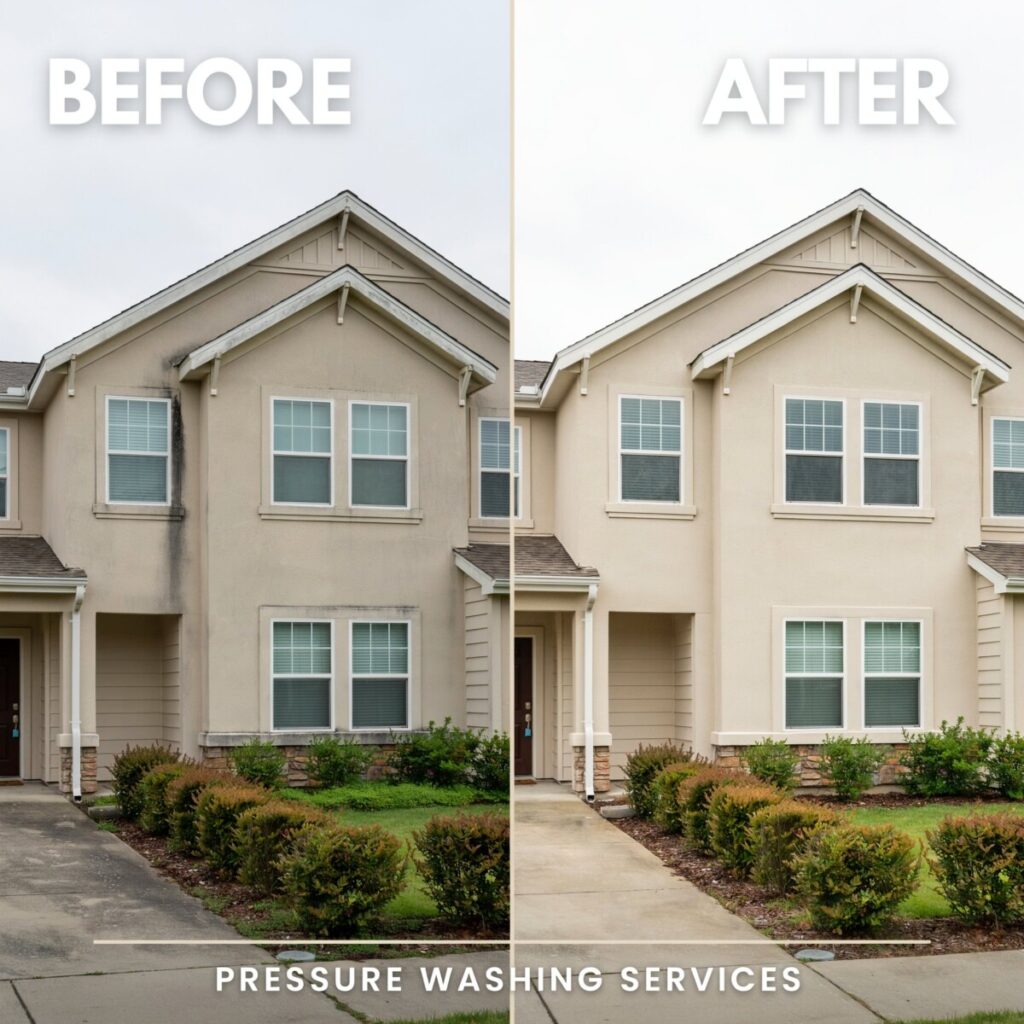
You pull into your driveway after a long weekend away, and the north-facing wall of your home looks like it belongs to a different house — dark green algae creeping up the siding, gray streaks running beneath every window, and a driveway that has gone from welcoming concrete to a blotchy canvas of oil stains and mildew. Now imagine that same wall just four hours later: bright, clean, and restored to the color you remember from move-in day. That is the transformative power of pressure washing home exteriors.
Pressure washing is one of the highest-impact, lowest-cost exterior maintenance steps a homeowner can take. According to the National Association of Realtors, strong curb appeal can increase a home’s perceived value by up to 7 percent, and a thorough exterior wash is often the single fastest way to achieve that boost. Industry data from the Pressure Washing Resource Association suggests that professional-grade pressure washing can remove up to 99% of surface mold, mildew, algae, and embedded grime in a single session — results that no garden hose or scrub brush can match.
Whether you are prepping to sell, protecting your siding from long-term biological damage, or simply reclaiming your home’s original beauty, understanding the before-and-after reality of pressure washing will help you decide whether to tackle the job yourself or call in a licensed professional.
What Is Pressure Washing — and How Does It Differ from Power Washing?
At its simplest, pressure washing uses a motorized pump to deliver water at high pressure through a narrow nozzle, mechanically stripping away dirt, mildew, grime, oxidation, and loose paint from exterior surfaces. The cleaning action comes from the force of the water, not from heat.
Power washing, by contrast, adds a heating element to the equation: the water is delivered at high pressure and high temperature (typically 180–210°F). Hot water dissolves grease, chewing gum, heavy oil stains, and deeply embedded organic matter far more effectively than cold water alone — but that added thermal energy also increases the risk of damaging softer surfaces like painted wood, older vinyl, or certain composite decking materials.
💡 Quick rule of thumb: Use cold-water pressure washing for most residential siding, decks, and routine maintenance. Reserve heated power washing for concrete driveways, heavily soiled pavers, and commercial grease removal.
Understanding PSI and GPM
Two numbers define every pressure washer’s capability:
| Metric | Meaning | Why it matters |
|---|---|---|
| PSI (pounds per square inch) | Water pressure — the force hitting the surface | Too high and you gouge, etch, or puncture; too low and nothing comes clean |
| GPM (gallons per minute) | Water flow — the volume rinsing debris away | Higher GPM rinses faster and reduces streaking on large surfaces |
Effective cleaning power is actually the product of both — often expressed as cleaning units (CU=PSI×GPM). A machine rated at 3,000 PSI and 2.5 GPM delivers 7,500 CU, which puts it squarely in the professional outdoor-equipment category.
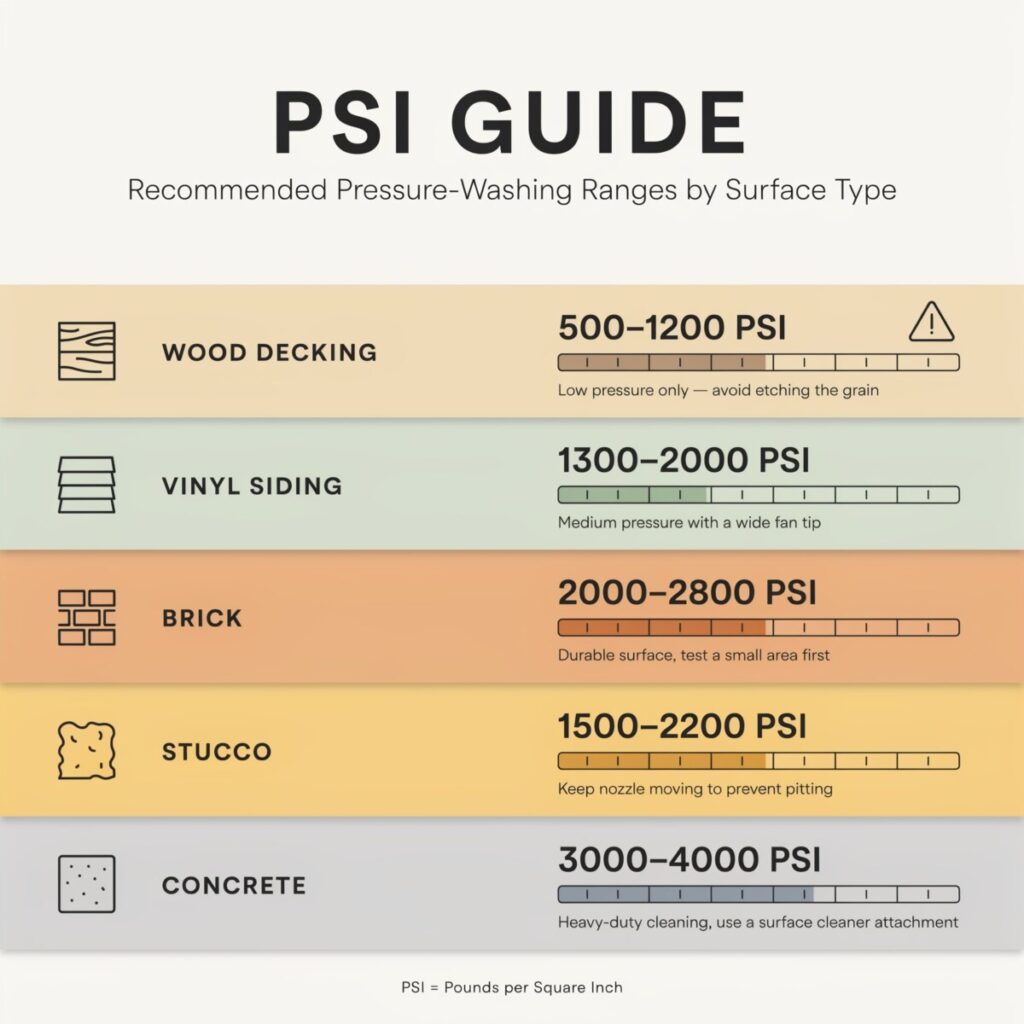
Recommended PSI by Exterior Surface
| Surface | Recommended PSI | Notes |
|---|---|---|
| Painted or stained soft wood | 500–800 PSI | Use a 40° white nozzle; keep wand ≥ 18″ from surface |
| Vinyl siding | 1,200–1,600 PSI | Angle spray downward to avoid forcing water behind panels |
| Fiber-cement (Hardie board) | 1,000–1,500 PSI | Avoid concentrating spray on seams or caulked joints |
| Brick, stone, and concrete block | 1,500–2,500 PSI | Pre-wet mortar joints; avoid aged or crumbling mortar |
| Stucco (traditional) | 800–1,200 PSI | Use wide fan tip; high PSI causes pitting |
| Concrete driveways and pavers | 2,500–3,500 PSI | A surface-cleaner attachment gives far more even results |
Common Reasons Homeowners Pressure Wash
Exterior pressure washing is rarely a one-motive decision. Most homeowners book the service — or rent the equipment — for a combination of aesthetic, protective, and financial reasons:
- Curb appeal and resale value. A freshly washed exterior reads as “well-maintained” to prospective buyers, appraisers, and neighbors. Listing agents consistently rank exterior cleaning among the top three pre-listing improvements for ROI.
- Preventative maintenance. Mold, algae, mildew, and moss are not just cosmetic problems — they retain moisture against siding, accelerate wood rot, degrade caulk, and can shorten the lifespan of paint systems by several years.
- Surface preparation for painting or staining. Paint adhesion fails most often on surfaces that still hold a microscopic layer of chalk, dirt, or biological film. Pressure washing is the industry-standard first step before any recoat.
- Driveway, deck, and fence restoration. Oil stains, tire marks, tannin bleed from leaves, and gray weathering on wood all respond dramatically to a properly calibrated wash.
- Seasonal deep cleans. After a long winter of road salt splash, pollen season, or fall leaf buildup, a scheduled wash resets the home’s exterior before the next season stresses it further.
Real-world example: A homeowner in suburban Charlotte listed her 2,100 sq ft ranch without pressure washing first. After 18 days on market with limited interest, her agent recommended an exterior wash and driveway cleaning — total cost $385. The home went back under contract within 6 days of relisting with updated photos.
The “Before” Condition: Signs Your Home Needs Pressure Washing
Not every home is a candidate for a wash today — but most will show clear signals within a few years of the last cleaning. Walk the full perimeter of your home in good daylight and look for these indicators:
Visible Signs
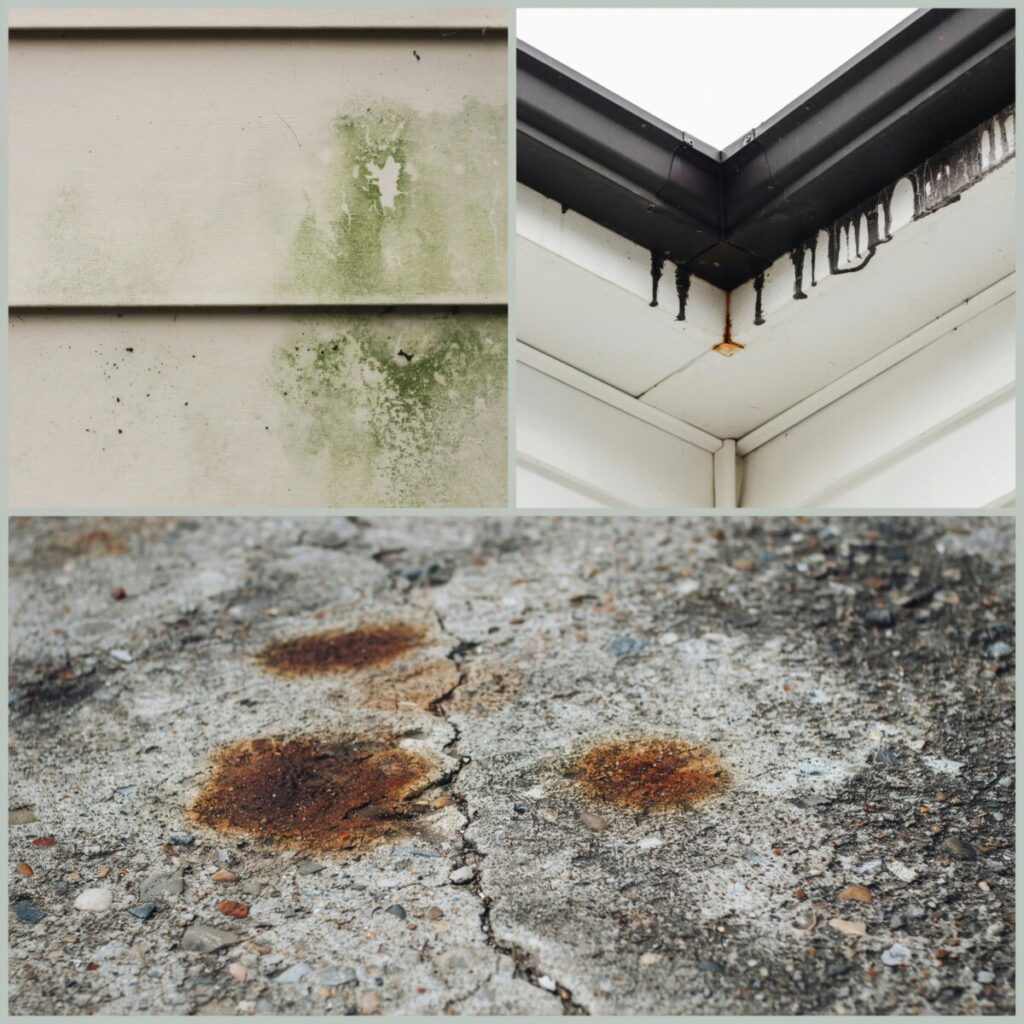
- Black streaks running below rooflines or gutters (gutter runoff laden with asphalt-granule debris and algae)
- Green or gray-green patches on north- and east-facing walls (algae and moss thrive in shade and moisture)
- Chalky residue on painted surfaces — run your hand across the siding; if it comes away dusty, oxidation is advancing
- Pollen buildup that no rainstorm seems to rinse away
- Oil, rust, or tire-mark stains on concrete and pavers
- Gum, sap drips, or bird-droppings that have bonded to surfaces
Functional Signs
- Clogged or overflowing gutters that dump water directly against siding
- Slow drainage or pooling near the foundation that encourages mildew at the base of walls
- Slippery decks, walkways, or pool surrounds — a serious slip-and-fall hazard, especially for households with children or older adults
- Musty odors on covered porches or enclosed patios, signaling hidden mold
Conduct a Quick Walkaround Inspection
Grab your phone and walk the full perimeter. Photograph every problem area with a reference object (a person, a yardstick, or a recognizable architectural detail) so you can document conditions before you wash — this is invaluable for insurance claims, warranty records, and before-and-after listing photography.
⚠️ Lead-paint safety reminder: If your home was built before 1978, exterior paint may contain lead. The EPA strongly recommends against high-pressure washing of lead-painted surfaces, which can aerosolize lead particles. Order a low-cost EPA-recognized lead test kit from any hardware store before you begin, and consult the EPA’s RRP Rule guidelines if lead is present.
The Pressure-Washing Process: What Happens During a Session
A professional-quality pressure wash is not simply “point and spray.” Whether you are doing it yourself or observing a hired crew, a well-executed session follows a consistent, safety-conscious workflow.
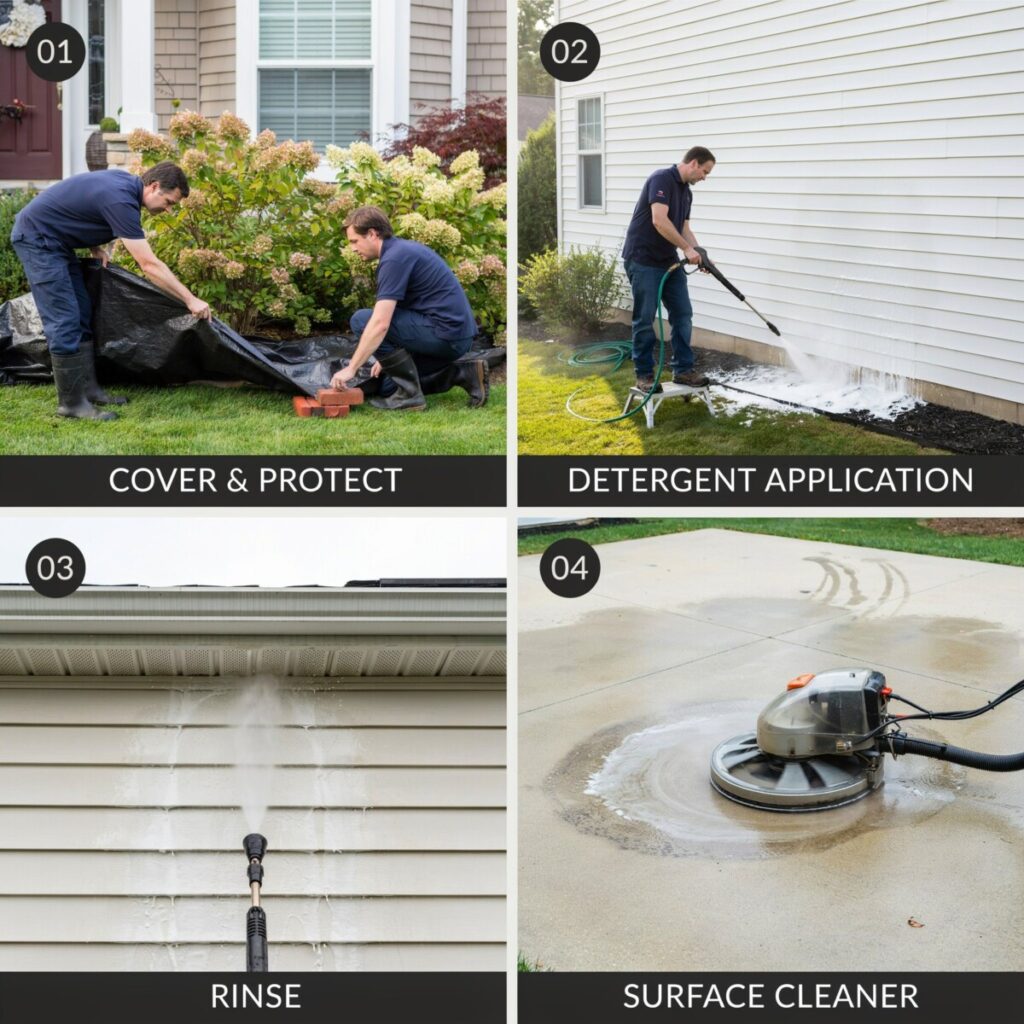
1. Pre-Inspection and Site Prep
- Walk the site and note loose siding, cracked stucco, failing caulk, uncovered electrical outlets, and damaged window seals
- Cover or wet down landscaping — sodium hypochlorite-based detergents can burn foliage, so pre-soaking plants and covering delicate shrubs with tarps is standard practice
- Close all windows and doors and inspect weatherstripping; water intrusion behind vinyl or fiber-cement panels is one of the most common DIY mistakes
- Move or cover outdoor furniture, grills, and light fixtures
2. Equipment Setup
- Select the correct nozzle: 0° (red, pinpoint, aggressive), 15° (yellow, stripping), 25° (green, general cleaning), 40° (white, delicate surfaces). Most home exteriors are washed at 25° or 40°.
- Confirm PSI and GPM settings for the surface at hand (see the table above)
- Decide between detergent-assisted washing (downstream or upstream chemical injection for mold and algae) and rinse-only (for light dust and pollen)
3. Step-by-Step Workflow
- Pre-wet the surface with plain water at low pressure to loosen surface dust
- Apply detergent (where appropriate) using a low-pressure soap nozzle or downstream injector; allow a 5–10 minute dwell time without letting the solution dry
- Rinse from top to bottom, maintaining a consistent 12–18″ distance and overlapping each pass by 30–50%
- Spot-treat stubborn stains with a turbo nozzle or dedicated concrete cleaner
- Use higher PSI and a surface-cleaner attachment on driveways and flat pavers for a uniform, streak-free finish
- Final rinse of plants and hardscape to neutralize any residual detergent
4. Safety Measures for DIYers
- Never climb a ladder while holding a pressurized wand — the reactive force can knock you off balance
- Wear PPE: safety goggles, closed-toe shoes, gloves, and hearing protection (gas-powered units exceed 85 dB)
- Keep the wand pointed away from people, pets, and electrical fixtures at all times
- Test a small, inconspicuous area first — if the surface etches, fuzzes, or loses paint adhesion, reduce pressure immediately
“A one-day pressure wash can restore curb appeal — and help prevent costly repairs later.”
5. When to Call a Licensed Professional
Hire a pro for multi-story homes, soft-wash applications requiring chemical mixing, fragile historic materials, documented mold remediation, or any surface known or suspected to contain lead paint. Expect a typical 1,800–2,500 sq ft single-story home wash to take 4–6 hours on-site, with U.S. market pricing roughly in the $250–$600 range for the exterior alone (driveways, decks, and roof washes are usually quoted separately).
The “After”: Results, Benefits, and Post-Clean Expectations
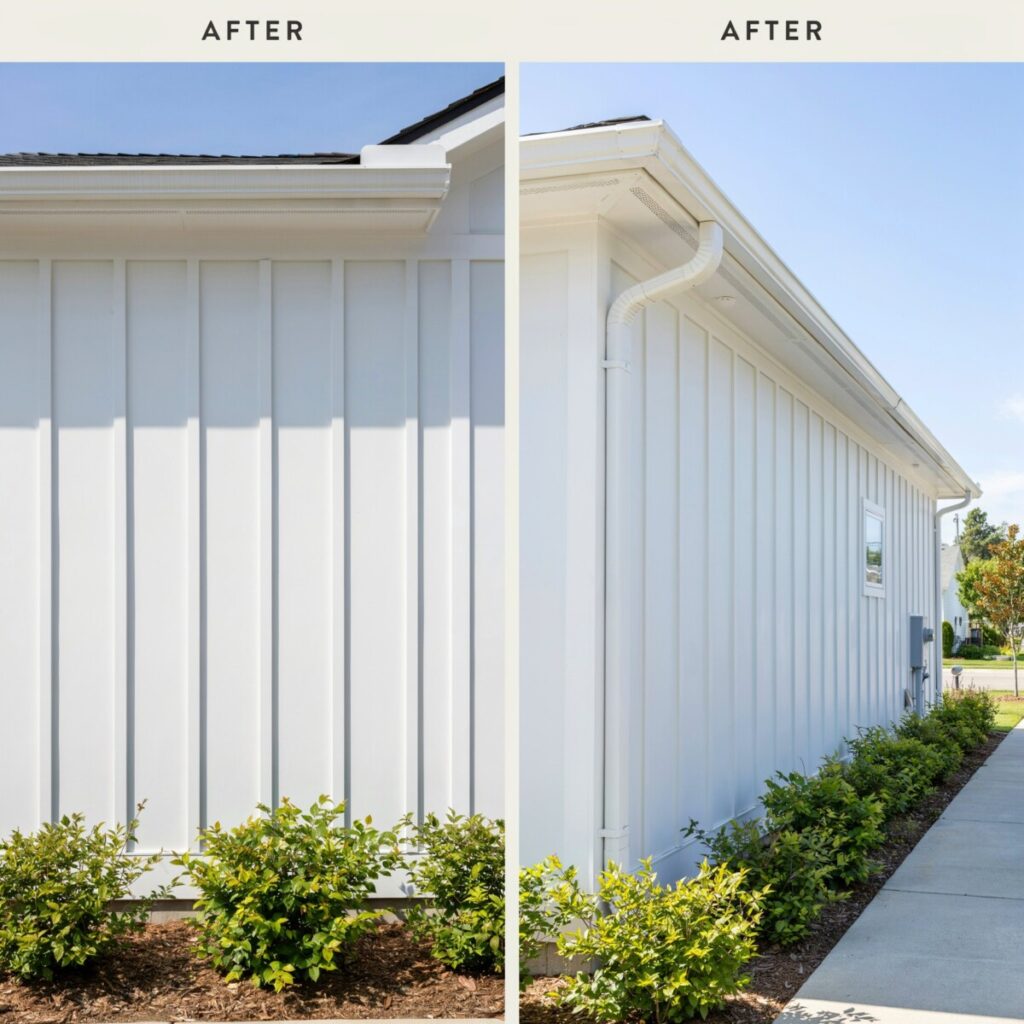
Visual Improvements You Will See Immediately
- Color restoration — vinyl, fiber-cement, and painted wood often return to within one shade of their original factory color
- Brighter trim and fascia — particularly noticeable on white and light-gray accents
- A dramatically cleaner driveway — oil stains may not vanish entirely without a degreaser pretreatment, but the overall concrete tone lifts several shades
- Elimination of slippery biofilm on decks, walkways, and pool surrounds
Functional Benefits That Last
- Reduced mold and mildew re-growth — removing the biological colony disrupts its lifecycle, buying you 12–24 months before meaningful re-accumulation
- Improved paint and stain adhesion — surfaces prepared by pressure washing consistently outperform hand-scrubbed surfaces in adhesion tests
- Extended lifespan for siding, decks, and fences — by eliminating moisture-trapping biological matter, you reduce the freeze-thaw and rot cycles that cause premature failure
Maintenance Tips to Prolong Results
- Avoid planting moisture-loving shrubs within 12–18 inches of siding — reduced airflow accelerates algae re-growth
- Clean gutters twice per year to eliminate the black-streak runoff cycle
- Schedule a maintenance wash every 12–24 months (annually in humid climates like the Southeast and Gulf Coast, biennially in drier western states)
- Apply a clear, breathable mildew-resistant coating on north-facing walls for added protection
Documenting Your Results
Take after-photos from the exact same position, angle, and time of day as your before-photos. Save these for listing materials, insurance records (especially relevant after storm-related grime events), and contractor warranty files.
📋 Downloadable: Pressure Washing Prep Checklist
- [ ] Walk perimeter and photograph all problem areas
- [ ] Test for lead paint (pre-1978 homes only)
- [ ] Close and latch all windows and doors
- [ ] Cover or pre-soak landscaping within 10 feet of wash zone
- [ ] Move outdoor furniture, grills, and potted plants
- [ ] Cover exterior electrical outlets and light fixtures
- [ ] Confirm PSI/GPM settings for each surface type
- [ ] Select correct nozzle for each surface
- [ ] Prepare detergent mix if using chemical wash
- [ ] Wear goggles, closed-toe shoes, gloves, and hearing protection
- [ ] Have a helper on-site for safety on larger jobs
Before-and-After Case Study: A Suburban Colonial in Atlanta
To illustrate a real-world transformation, consider a 2,400 sq ft two-story colonial built in 1998, located in a shaded, tree-lined neighborhood outside Atlanta, Georgia. The north and east walls showed heavy green algae colonization — exacerbated by dense oak canopy, poor airflow, and gutters that had not been cleaned in three years. The concrete driveway showed moderate oil staining near the garage pad and general graying from UV exposure.
Scope of Work
- Gutter cleaning and downspout flush
- Soft wash of north and east siding using a 0.5–1% sodium hypochlorite solution at 500 PSI via downstream injection
- Standard pressure wash of south and west vinyl siding at 1,400 PSI
- Driveway degreaser pretreatment followed by 3,000 PSI surface-cleaner pass
- Full landscaping pre-soak and post-rinse
Results
| Metric | Before | After |
|---|---|---|
| Visible algae coverage (north wall, estimated) | ~65% of surface area | < 5% (spot-treated remnants near soffits) |
| Driveway oil stain visibility | Dark, clearly defined (~8 sq ft) | Faded to faint shadow, largely unnoticeable |
| Overall exterior brightness (subjective) | Dull, yellowed | Restored to near-original warm white |
Cost and Time
- Labor: Two-person crew, approximately 5.5 hours on-site
- Total cost: $625 (inclusive of detergent, degreaser, and gutter cleaning; priced for the Southeast U.S. market in spring 2025)
- Homeowner feedback: Listed the home four weeks later; agent credited the exterior refresh for generating strong first-week showing traffic
Costs, ROI, and Value Considerations
Pressure washing cost varies by home size, number of stories, surface material, staining severity, accessibility, and local labor rates. Broad U.S. market ranges as of 2025–2026:
| Service | Typical Price Range |
|---|---|
| Single-story house wash (1,500–2,500 sq ft) | $250–$550 |
| Two-story house wash (2,000–3,500 sq ft) | $400–$850 |
| Driveway and walkway cleaning | $100–$300 |
| Deck or fence cleaning | $150–$400 |
| Full exterior + driveway + deck package | $550–$1,200 |
| DIY rental (gas pressure washer, daily rate) | $60–$120/day |
Is the ROI Worth It?
The numbers consistently say yes. The National Association of Realtors and HomeAdvisor (now part of Angi) have both reported that exterior cleaning and landscaping together recoup 85–100% of their cost at resale in the form of faster sales and higher perceived value. For homeowners not selling, the ROI comes in prevented costs: delayed repainting, avoided siding replacement, and reduced mold-related repair bills.
💡 Tip: Always get at least three written estimates and confirm that the contractor carries general liability insurance and is familiar with soft-wash techniques for delicate surfaces.
FAQs and Safety Reminders
❓ How often should you pressure wash your house exterior?
Every 12–18 months in humid or heavily wooded climates; every 24–36 months in drier, sunnier regions.
❓ Can you pressure wash painted surfaces without damage?
Yes — at low PSI (500–1,000) with a wide fan nozzle and proper distance. Always test an inconspicuous area first.
❓ Will pressure washing alone remove mold?
It removes surface mold effectively. For mold that has penetrated porous materials, chemical treatment (soft washing) or physical remediation is required.
❓ Is pressure washing safe for windows?
At close range and high PSI, no — it can break seals and crack glass. Keep the wand at least 3 feet from windows and use a 40° nozzle at reduced pressure.
❓ When should you NOT pressure wash?
In freezing temperatures, during high winds, on surfaces with known lead paint, or on electrical fixtures and HVAC units not rated for wet exposure.
Core safety reminders: Never exceed the recommended PSI for a surface. Protect landscaping from chemical runoff. Wear full PPE. Avoid ladders. And when in doubt, hire a licensed professional.
Your Next Step: Take the Walkaround
Grab your phone, walk the perimeter of your home this weekend, and take honest before-photos of every wall, the driveway, and the deck. Those images will tell you — better than any article can — whether a pressure wash is overdue. For simple single-story vinyl siding and concrete, a careful DIY approach with a rental unit can yield outstanding results in a single afternoon. For multi-story homes, fragile materials, or any suspicion of lead paint or deep mold, call a licensed exterior cleaning professional and request a free written estimate.
A one-day pressure wash can restore curb appeal — and help prevent costly repairs later.
💬 Have you pressure washed your home recently? Share your before-and-after photos, questions, or lessons learned in the comments below — we read every one.